



Introduction
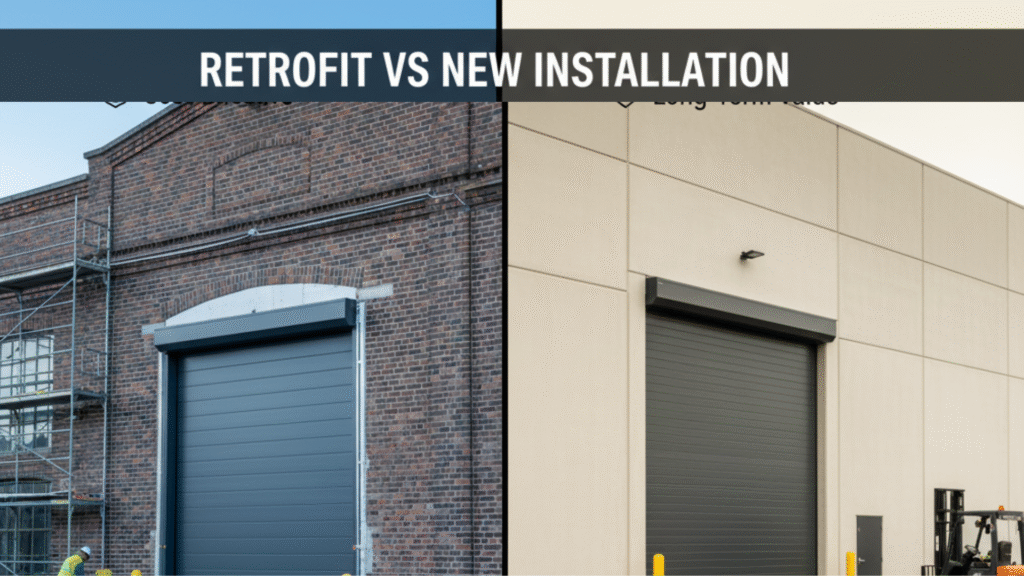
When your facility’s doorways begin displaying wear, you face a critical choice — Retrofit vs New Installation. Both alternatives affect your budget, downtime, and long-term efficiency. As a pacesetter in industrial automation and door solutions, Nihva allows companies to make data-driven alternatives that stabilize value, performance, and reliability.
Upgrading industrial doors isn’t just renovation; it’s modernization. The proper method guarantees protection compliance, power performance, and a stepped forward workflow. But that’s in reality the smarter circulate: Retrofit vs New Installation?
Understanding Retrofit vs New Installation
What Is a Retrofit?
A retrofit involves upgrading existing door systems with new generation sensors, operators, protection mechanisms, or insulation — without changing the entire structure. It’s a cheap, faster alternative that reuses present hardware and framing.
What Is a New Installation?
A new setup replaces the complete door assembly, together with frames, panels, motors, and manage structures. This choice provides the trendy features and the longest lifespan but entails a higher upfront price and longer installation time.
Nihva specializes in both retrofit and full installation offerings, assisting clients in comparing return on investment (ROI), safety enhancements, and operational performance before selecting.
Benefits of Retrofit Solutions
When considering Retrofit vs New Installation, retrofitting is regularly preferred for facilities that need modernization without structural modifications.
Key advantages include:
Cost Efficiency: Reusing present door frames reduces fabrication and labor costs.
Faster Implementation: Minimal downtime since no major structural change is wanted.
Sustainability: Lower material waste and electricity intake.
Technology Upgrade: Add automation, IoT sensors, or stepped forward sealing to older doorways.
Example: A warehouse with functional sectional doorways can retrofit them with Nihva’s smart operators and safety sensors, gaining automation at a fraction of the alternative price.
Benefits of New Installations
A new installation makes sense when doorways are beyond repair or incompatible with contemporary automation. In the Retrofit vs New Installation debate, the alternative is ideal for maximizing performance and reliability.
Key blessings include:
- Full Customization: Choose door type, materials, and automation appropriate to precise operations.
- Compliance and Safety: Meets the modern-day fireplace, insulation, and get entry to rules.
- Enhanced Efficiency: New systems reduce power loss and operational noise.
- Longer Lifespan: Factory-sparkling substances mean lower maintenance wishes.
Nihva’s new commercial door installations include superior high-speed doors, rolling shutters, and sectional systems designed for long-term reliability in stressful environments.
How to Decide: Retrofit vs New Installation
To make the right selection, facility managers have to investigate several elements:
Door Condition: If the shape and panels are sound, retrofit is cost-efficient.
Operational Requirements: For new automation or higher throughput, complete replacement may be required.
Budget and Downtime: Retrofits provide quicker ROI with minimal disruption.
Future Scalability: New installations provide higher long-term adaptability for Industry four.0 environments.
Nihva’s engineers perform website audits to analyze mechanical integrity, safety dangers, and improve capacity, making sure each client receives a customized recommendation on Retrofit vs New Installation.
Cost and ROI Comparison
When comparing Retrofit vs New Installation, bear in mind overall lifecycle charges as opposed to the initial fee alone.
Retrofit: 30 – 50 % inexpensive in advance; ROI usually achieved within 12–18 months.
New Installation: Higher initial price, however, decreased long-term upkeep and power payments.
By the use of Nihva’s automation components and electricity-green door structures, clients regularly reap measurable power financial savings and improved protection compliance, similarly enhancing ROI.
Common Mistakes to Avoid
- Ignoring Structural Weaknesses: Retrofitting on vulnerable frames can cause frequent breakdowns.
- Choosing Cost Over Quality: Cheap installations lessen long-term price.
- Skipping Professional Assessment: Always rely on specialists like Nihva for load analysis and automation compatibility exams.
Conclusion
The Retrofit vs New Installation decision depends on the age, situation, and performance goals of your facility’s doorways. Retrofitting is cost-effective and brief, whilst new installations offer the first-rate, lengthy-time period modernization capacity.
With huge experience in door automation and warehousing solutions, Nihva gives both retrofit improvements and complete-scale installations subsidized via professional engineering help.